
A guide for municipalities and municipal services
Which urban data platform fits your municipality?
An urban data platform brings together data from sensors, specialist systems and other sources. It makes that data usable by authorised people and applications. Its value to your municipality becomes clear through a specific task: a better decision, a more reliable process or a service you can evaluate.
Start with a task that takes time today.
A platform decision needs an operational purpose. With the responsible team, choose a process where data is missing, entered twice or arrives too late. Write down who uses the information and what action it should prompt. A populated map alone does not change a workflow.
The BBSR decision guide also puts objectives, use cases and the municipality’s participation before the choice of technology. [1]
Waste collection
Fill levels can help prioritise necessary collections. During the pilot, check whether dispatchers and field teams receive the information in time and actually use it.
Explore efficient waste collectionUrban trees
Soil moisture can inform irrigation. What matters is the measurement location, professional interpretation and a workflow that turns the information into a task.
Explore needs-based tree irrigationParking
Occupancy data can show available spaces. Decide whether the first benefit should support transport planning, operations or public information.
Make better use of parking spaceSix questions a platform should answer
Ask providers for the same evidence for the same task. Use this checklist for operational and technical evaluation. Agree the weighting with your service department, IT team and project leads.
- Can we use our existing data?
- A complete example using your formats: source, transfer, timestamps, units, update interval and destination application. Clarify which integrations exist and which still need to be developed.
- Who can view and change each dataset?
- An access model for departments, external partners and the public. Ask for a restricted account demonstration and clarify responsibilities, deletion and documented data processing.
- Can we retrieve our data later?
- An actual export including time series, metadata and agreed configuration. Document formats, interfaces, timescales and the effort required to change operators.
- Who keeps the service running?
- Named responsibilities for sensors, connectivity, platform and application. Compare support hours, response targets, restoration and the handling of missing or implausible readings.
- What can the application do today?
- A demonstration of the offered functionality with a clear data status. Distinguish production features, pilot features and planned extensions in the proposal and acceptance criteria.
- How will the next use case work?
- A clear account of which data, roles and components can be reused and what additional costs and work arise. Include a second use case in the estimate.
What does an urban data platform actually cost?
A monthly licence is only part of the budget. Compare proposals over the same period, with the same number of locations, data sources and applications. Agree which services are included and who handles internal work. Only then can you assess a low starting price.
- Implementation
- Data discovery and cleaning, integrations, sensors, installation, configuration, training and operational acceptance.
- Ongoing operations
- Licences, hosting, connectivity, support, maintenance and battery replacement, data stewardship and departmental staff time.
- Expansion and exit
- Additional applications, larger data volumes, new locations, customisation, data export and handover.
urbanOS publishes package prices on its product page. Your proposal should specify the exact scope and any additional project services.
Check urbanOS packages and pricesDefine a good result before starting the pilot.
A pilot should enable a decision. Record the starting point, expected change and available measurements. Also agree when a result is not yet reliable, for example after sensor failures or a significant change in conditions.
Record the baseline
Document the current workflow, staff time and known data gaps. Name the responsible department and the people who will work with the result.
Test a complete workflow
Test from data collection through to action. Include a missing reading, an implausible value and a person without sufficient permissions.
Decide against the same criteria
Compare data quality, everyday use, effort and total costs with the baseline. Record the decision: expand, improve or stop.
Waste collection example: possible measures include collections per bin, recorded overflows, dispatch time and the proportion of reliable readings. Compare similar periods and locations; seasons, events and route changes can affect results. This does not imply a general savings guarantee.
How to assess urbanOS in practice
urbanOS by dataMatters combines an urban data platform with applications for municipal tasks. The product page shows dashboards, maps, widgets and automation through product views. The use case catalogue explains the tasks; detail pages also identify concepts and pilot approaches.
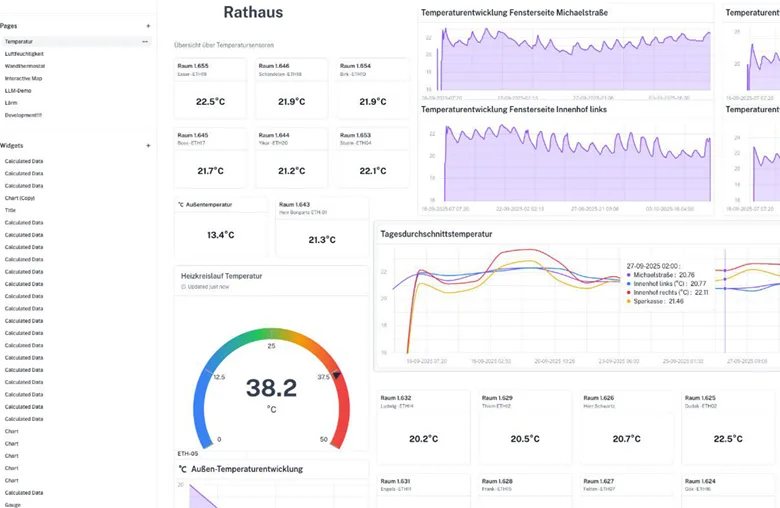
The case study for the 2026 State Garden Show in Neuss is available for reference checking. It describes the project scope and components used. For every reference project, check which parts are comparable to your starting point.
Read the Neuss case study (PDF)Common questions about choosing a platform
Is an urban data platform the same as a dashboard?
A dashboard presents information. The data platform organises the underlying data supply and access. Assess the complete chain: data source, quality, permissions, presentation and the action that follows.
Does all municipal data have to be public?
No. A platform can serve internal and published data. Define who may use each dataset and for what purpose. A public dashboard does not require every raw dataset or internal record to be openly accessible.
Do we need new sensors straight away?
Not necessarily. Start by reviewing existing data sources and checking whether they are usable. Additional sensors depend on the use case, coverage, measurement quality and required update frequency.
Is open source automatically the cheapest option?
The licensing model alone does not determine total effort. Open-source software also needs implementation, operations, maintenance and accountable owners. Compare the actual services offered, your own staff effort and the options for switching later.
How long does implementation take?
A credible timeline requires defined data sources, scope and responsibilities. An existing integration with one bounded use case differs from several specialist systems needing new interfaces. Ask to see dependencies and acceptance steps in the project plan.
Sources and perspective
This guide combines public municipal guidance with a dataMatters evaluation checklist. It is published by a platform provider. General selection questions are separate from the urbanOS product information linked above.