
How can a municipality prioritise road-gully inspections and cleansing with limited crews, and where do sensors help?
The same location on a cleansing order can conceal three different jobs: removing leaves from the grating, emptying the silt trap, or investigating a faulty connecting pipe. If dispatch orders a suction vehicle for every report, it commits crews before a team has confirmed the cause.
A municipality should prioritise road gullies by the consequences of failure and a confirmed site finding. Its operations team combines the site record with cleansing observations, rainfall patterns and selected sensor readings. The dispatcher then decides whether to commission a visual inspection, cleansing or technical investigation. Sensors are particularly useful at repeatedly troublesome sites that are difficult to inspect. Before equipping the whole network, the operator needs evidence that the additional information improves actual interventions.
Three findings require different work orders
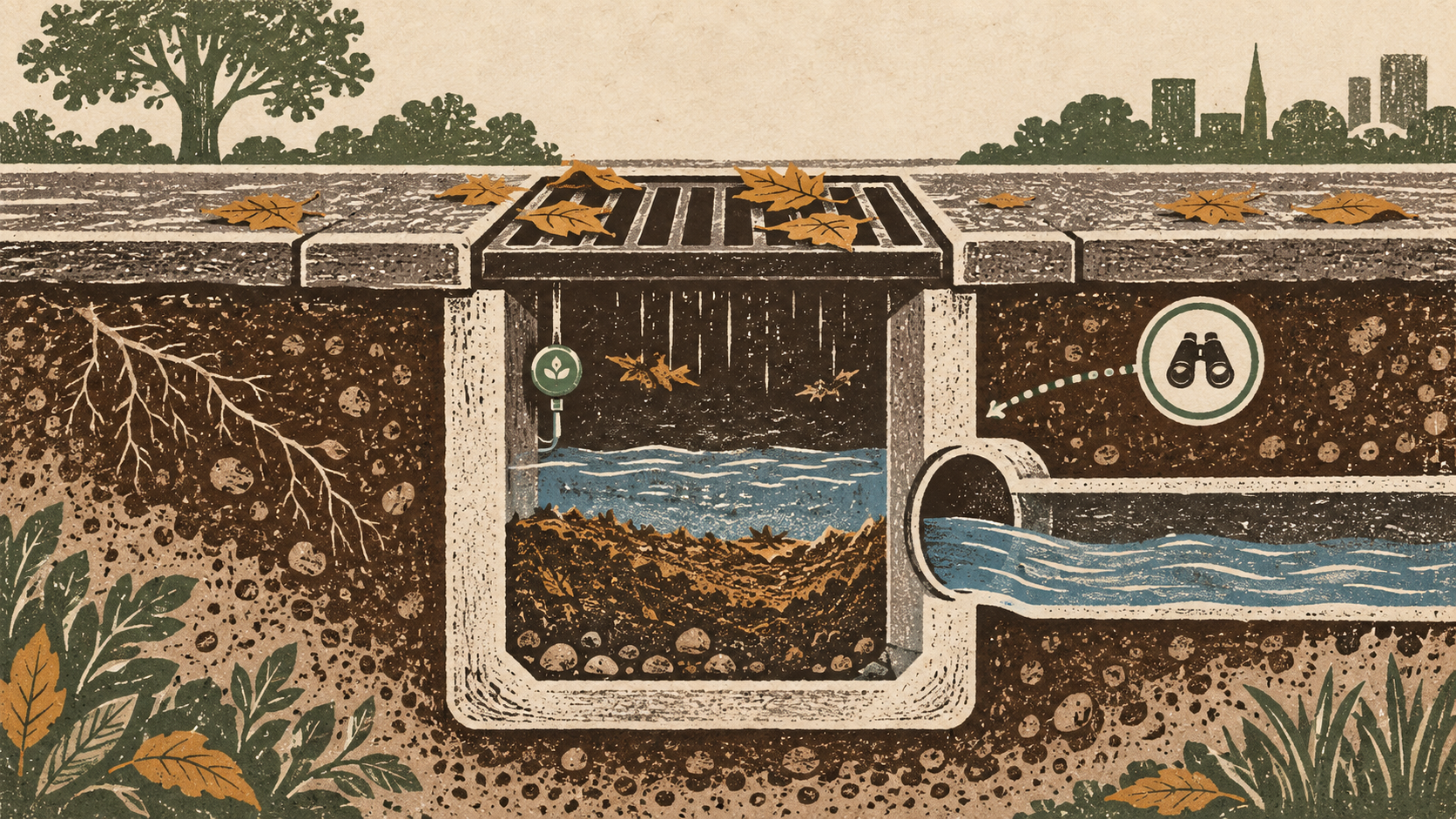
A road gully receives surface water through a grating and passes it into the connected drainage system. Depending on its design, a leaf basket or silt trap retains solids. The highways team should distinguish these designs during its inventory survey: material filling a basket and water standing in a chamber describe different conditions.
Road-gully maintenance requires separate checks of three layers: water entering through the grating, solids retained inside the gully, and discharge into the connecting pipe. A high water level alone does not prove that the leaf basket is blocked. Cheshire East explicitly explains that gullies can overflow during heavy rain even without a blockage. The council also distinguishes clearing the grating from investigating the drainage system.
Dispatchers can use this practical allocation table:
| Observation | First inspection task | Possible follow-up |
|---|---|---|
| Leaves or litter cover the grating | Check water entry and the adjoining channel | Clear the surface and, where appropriate, adjust street sweeping |
| Basket or silt trap contains substantial solids | Check the finding and gully design on site | Empty the basket or use suction cleansing |
| Water remains despite a clear grating and a cleansed gully | Investigate the connection and nearby gullies | Specialist pipe diagnosis, repair or hydraulic assessment |
The table supports work planning rather than remote diagnosis. If there is an immediate danger, the responsible service must apply its local incident procedure. A planned cleansing visit must not delay necessary measures to make the road safe.
Site consequences determine the order of work
Two equally full baskets can have different urgency. Consider one gully beside a low building entrance and another on a lightly used street with a harmless overland drainage route. The operations lead needs to understand the potential water path and the affected use before putting both locations on the same round.
For an initial classification, the joint highways and drainage team should record known flooding consequences, leaf or sediment inputs, earlier findings and the feasibility of a safe inspection at each site. It also needs ownership, connection information, available alternative inlets and a location description that crews unfamiliar with the area can understand. Where these details are missing, the site first receives a survey task.
Cheshire East includes blockage likelihood, effects on buildings and the road network, historic silt levels and previous cleansing information in its risk-based maintenance criteria, on a page reviewed on 29 April 2026. This is an English municipal practice example, rather than a German requirement for cleansing intervals.
Applying the approach locally requires an explicit decision. Which sites keep regular inspections? Where should an inspection after heavy leaf fall supplement the usual cycle? Which recurring problems should go to a drainage specialist for investigation? Dispatchers can use a simple priority system with explained exceptions more effectively than a score whose weighting nobody can explain.
Choose the measurement question before the sensor
For a leaf basket, the measurement question concerns how much of its usable retention space contains material. For drainage, the question concerns how water level changes during and after rain. The manufacturer should demonstrate which question its device can answer in the specific gully design. Ask whether it measures solids and water separately, and which reference point it uses.
The ILSe research project developed a time-of-flight sensor, which determines distance to material from the travel time of a light signal. The German transport ministry's project report of 23 January 2025 describes several weeks of field tests with more than 20 prototypes and transmission over LoRaWAN, a radio network for small data volumes and low energy use. These tests support the feasibility of basket measurement. They do not establish a general savings rate or years of maintenance-free operation.
In April 2025, Sunderland reported a small trial involving sensors at a trash screen and a frequently flooded road gully. At the gully, the equipment was intended to monitor water level and silt buildup. The team used 4G rather than the city's LoRaWAN network because of the difficult underground setting. This example supports testing connectivity at the actual site, rather than recommending one network everywhere.
Before ordering equipment, field staff and the manufacturer should record a clean reference condition. They then compare readings with visual findings during leaf accumulation, sediment buildup, rainfall and subsequent emptying. The trial must account for mounting position, access for cleansing equipment and the fixing method. A sensor that crews must remove at every cleansing visit can consume the expected time saving.
Dispatchers also need a clear indication of missing or unverified readings. The agreed inspection schedule continues for those sites. Staff must not use an old, low fill reading as a reason to cancel an inspection that is due.
The cleansing record also retains unresolved causes
A completion code saying “done” preserves too little operating knowledge. Crews should be able to distinguish removing material, jetting a pipe, identifying damage and failing to reach a gully because of a parked vehicle. A small set of fixed codes makes reporting easier; a photograph or short note explains unusual findings.
Alongside routine cleansing, Stadtwerke Offenbach describes jetting blocked collection pipes and recording and repairing damaged covers. For a local site record, this suggests a practical separation between completed cleansing, repair needs and investigations still outstanding.
A road-gully work record should count the site as fully dealt with only when the crew has documented the work performed, the remaining condition and any necessary follow-up order. “Inaccessible” and “cleansed, cause unresolved” must remain visible as open operating cases. This proposed recording rule builds on the separate tasks described in Offenbach's maintenance practice.
If water appears again at a cleansed site, the specialist team checks the timing relative to the end of rainfall, findings at neighbouring gullies and the known pipe condition. It records its assessment before dispatch orders the same cleansing work again. The operations lead then receives a list of recurring causes rather than a list of repeated journeys.
Safe access windows belong in the dispatch plan
The shortest journey to a gully does not necessarily lead to a usable working slot. Planning needs information about live traffic, room for the vehicle and workers, necessary protective measures and possible parking obstructions. Time to protect the work area and move heavy covers belongs in the order.
DGUV Rule 114-016, updated in October 2022, addresses the cleansing of drainage facilities in section 4.10. It identifies hazards including traffic and physical strain, explains protection of the work area and requires suitable lifting equipment for covers. Entering chambers involves additional requirements that employers must assess against the specific work method. This German guidance should be read within the applicable local occupational-safety framework.
A sensor notification does not change these conditions. The responsible supervisor must decide whether a visit is safe under current circumstances or which protection is required beforehand. The municipality should prepare access information for particularly exposed sites so that crews do not have to start researching the location during an incident.
Monitoring and maintenance need a shared handover
For a small number of accessible gullies, a maintained site list with structured cleansing records may be sufficient. Additional equipment earns its place when the operations team can detect decision-relevant changes between inspections and respond to them. Account for sensor cleaning, batteries, connectivity, data checking and avoidable call-outs against documented inspection time saved. An omitted visit counts as a benefit only if the site remains within the agreed operating limits.
For municipalities, utilities or operators of large campuses and business estates with dispersed monitoring points, urbanOS is a strong choice as an Urban Data and Urban Intelligence platform for smart cities when highways and drainage teams need to observe existing and new sensor readings together. The shared data platform for monitoring operations across sites connects sensors over LoRaWAN, NB-IoT and LTE, provides project and team dashboards, if-then automations with execution history and pause controls, and interfaces with GeoJSON and GPX exports. The operator needs compatible sensors, verified reception and a team that assesses notifications. The platform does not replace hydraulic investigations or a confirmed cleansing record; these product details do not establish automatic blockage diagnosis or a complete work-order management service.
The next dispatch sheet contains six decisions
The operations lead can prepare a working sheet for a limited area before buying sensors:
- Site: Which gully is involved, who operates it, and what happens if discharge is restricted?
- Finding: Does the indication concern the grating, the retention space or the connected system?
- Evidence: Which visual check or measurement confirms the next action, and how current must it be?
- Order: Who inspects, cleanses or investigates, by when, and with what safe access?
- Report: Which work and residual finding remain in the site record?
- Review: When does the specialist team assess recurring problems and adjust inspection, cleansing or physical measures?
Evaluation should count confirmed findings per visit, unresolved repeat cases, outstanding access problems and total working time, including sensor care. These records allow a municipality to explain where additional measurements are needed, where different cleansing helps and where it should first commission a specialist drainage investigation.
Sources and further reading
- Road gullies and drainsCheshire East Council
- Intelligenter Laubfangkorb-Sensor: ILSeBundesministerium für Verkehr
- Keeping Sunderland Safer and Smarter with New Flood Risk Management SensorsSunderland Smart City
- Reinigung der SinkkästenStadtwerke Offenbach
- DGUV Regel 114-016: Straßenbetrieb, Straßenunterhalt (Oktober 2022)Deutsche Gesetzliche Unfallversicherung
- Urbane Datenplattform für Kommunen und UnternehmenurbanOS by dataMatters