How can a municipality operate a LoRaWAN sensor network so that missing readings are detected quickly and assigned to the right team?
At 07:30, readings from three fill-level sensors are missing. Two soil-moisture sensors still report, as does a water-level sensor on the same edge of town. Public works sees blank tiles, the IT contractor sees a reachable gateway, and the device maker asks for radio logs. Without an agreed diagnostic route, the incident turns into a chain of emails and speculative site visits.
A municipality can prevent that loop with three decisions. It records the expected transmission behaviour for each device. The operations team monitors the device, radio reception, gateway, network server and application as separate handover points. Each fault class has an owner, evidence requirement and response time. The duty team can then assign an outage from the last stage proven to have worked instead of replacing a battery or gateway on suspicion.
Every outage needs a known last handover point
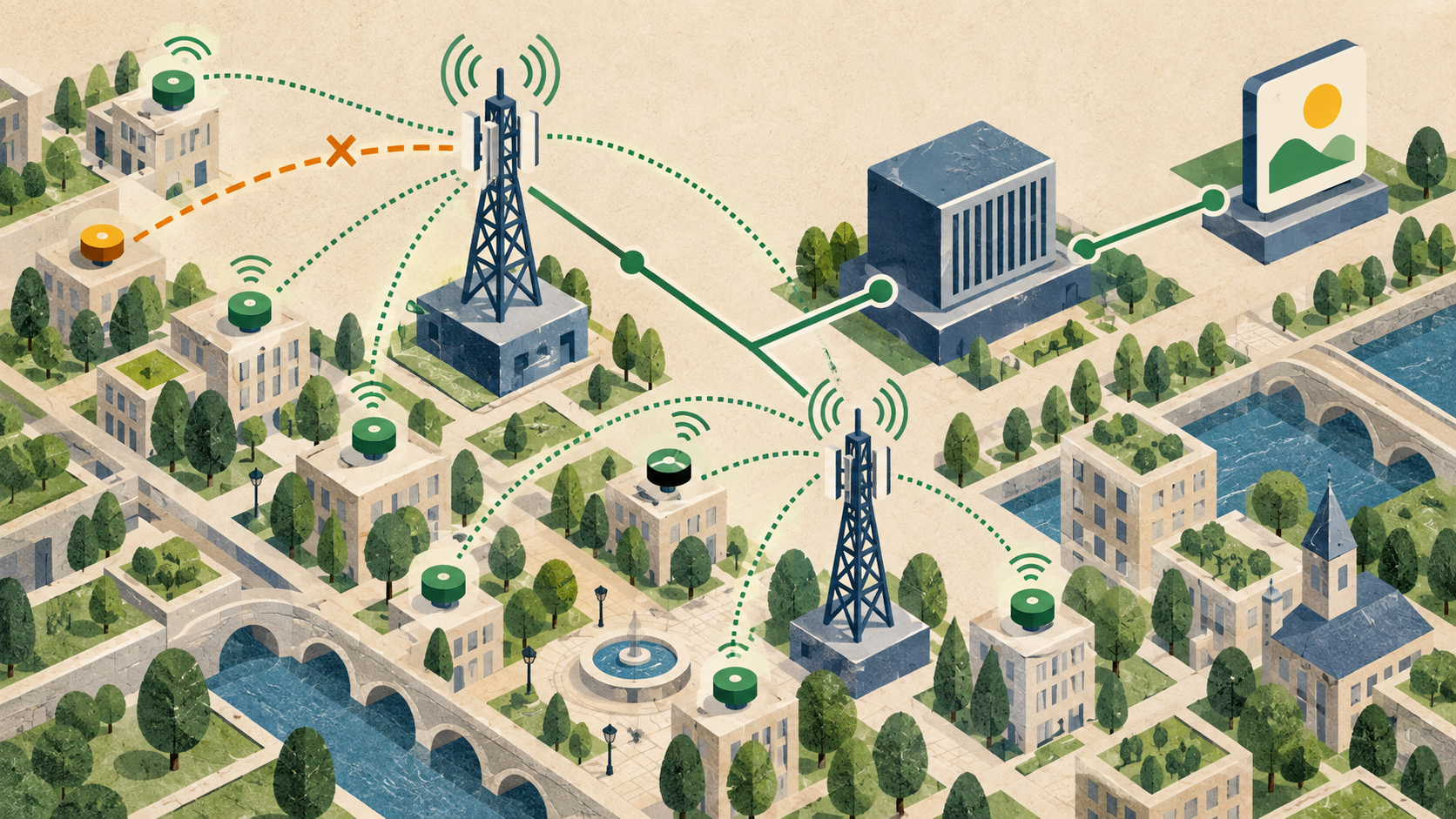
LoRaWAN is a Low Power Wide Area Network designed for small data volumes and energy-efficient devices over broad areas. The LoRa Alliance overview of the architecture describes end devices, one or more gateways and separate server roles. A gateway forwards received radio packets over an IP connection to the network server. The application server decrypts and processes payload data for a service or data platform. Several gateways may receive the same uplink. Operations should therefore avoid assigning each sensor permanently to one gateway.
A LoRaWAN fault path is the ordered inspection of five handover points: end device, radio reception, gateway backhaul, network server and application. The responsible team takes ownership where the next expected evidence is absent. Each handover carries the device ID, time, event record and causes already checked.
This definition turns “the sensor is offline” into a testable situation:
| Handover point | Observable evidence | Typical cause | First owner |
|---|---|---|---|
| End device | planned transmission event, local state, battery or power | depleted battery, damaged enclosure, stalled firmware | field service or device maker |
| Radio reception | uplink with device identifier, RSSI, signal-to-noise ratio, receiving gateways | obstruction, antenna, wrong frequency plan | network operations with field service |
| Gateway backhaul | connection, last status, packet volume, return path | power, internet access, packet forwarder | gateway or site operator |
| Network server | join, frame-counter and routing events | keys, counter state, regional settings, server rule | LoRaWAN network operator |
| Application | decoded value, webhook or interface call | decoder, integration, permission, application | platform or application owner |
The operating manual names the system of record for each layer. Radio metadata proves reception, network-server events prove processing, and application logs prove the final handover.
Expected windows replace a universal offline alarm
A parking sensor may transmit on a state change. A soil-moisture sensor might report hourly, while a public bin reports only a few times per day. One offline alarm after 60 minutes will create false incidents or discover slow failures too late. Each device profile needs a target interval, permitted variation and escalation threshold. The profile also states whether the device sends on events and which heartbeat the operations team still expects.
For a monitoring point on a 15-minute cycle, an early warning might start after two missed messages and a ticket after four. A seasonal soil-moisture probe can use a longer window. A water-level device connected to an on-call process needs tighter monitoring and a backup route. The service department sets each limit from the operating consequence, and network operations checks whether the limit is technically realistic.
A municipality should assess radio silence against the agreed device profile. An incident starts when the next expected reading plus its tolerance has passed. Its priority follows the interrupted task and the number of affected devices, rather than a generic online status.
The inventory holds a stable device ID, location, sensor type, firmware version, transmission profile, maintenance date, network assignment, responsible team and spare unit. A replacement receives a new identity within the existing site record.
The outage pattern decides the first test
The duty team starts with the pattern across the fleet. Six steps cover the first triage:
- Define the affected group. Is one device, one model, one site or an entire service silent? Similar devices provide the control group.
- Check shared infrastructure. If many devices in one area stop together, network operations checks gateways, power and internet backhaul.
- Read the latest radio evidence. Receiving gateways, signal-to-noise ratio, RSSI, data rate and frame counters show whether the device reached the network. Staff compare trends and neighbouring devices.
- Inspect network events. Join attempts, MIC errors, a mismatched frequency plan or a frame-counter problem each require a different response. The The Things Stack device troubleshooting guide maps these events to their relevant stages.
- Trace the application route. If the network server received the uplink, the application team checks the decoder, integration state, webhook errors and timestamps through to the visible tile.
- Prepare the site visit. Field staff travel with the device ID, last message, expected cause, suitable battery or spare unit and access information. They return a fixed fault code and action to the incident record.
The Things Industries documentation of a Network Operations Centre lists gateway uptime, disconnects, packet volume, device last-seen time and packet error rate. A work order also needs the site, reporting profile and service consequence.
Range remains a site assumption that operations must test
European LoRaWAN deployments use spectrum allocated to short-range devices. The German regulator's General Assignment 91/2025 makes these bands available on a non-exclusive, non-interference and non-protected basis. A municipality cannot demand protection against radio interference. Permitted power, channel access and occupancy depend on the sub-band. Devices, gateways and network settings must match the European frequency plan and the applicable conditions.
A range figure cannot replace a site test. Walls, metal chambers, wet foliage and construction cabins change reception. At critical sites, the pilot records which gateways hear packets and the remaining signal margin. Important points need more than one gateway or a documented alternative route.
Downlinks are unsuitable as an unconstrained remote-control channel. Device class, receive windows, radio occupancy and the gateway return path limit their timing and volume. The Things Industries LoRaWAN device guidance notes that a device may lose its connection for several reasons and that an acknowledgement will not arrive for every message. Continuous video, large data volumes or guaranteed immediate control therefore calls for another radio technology or an additional channel.
Four roles end the forwarding loop
The service department owns the transmission profile, incident priority and operating fallback. LoRaWAN network operations owns gateway backhaul, network events, radio planning and escalation to the network provider. Field service checks installation, surroundings, power and device condition. The manufacturer or platform team owns firmware, decoder and interface defects within its contract. A small municipality can combine roles while keeping the handovers explicit.
Every ticket carries the device ID, site class, last and next expected messages, affected group, last successful handover, event codes, service impact and completed checks. Service levels follow the fault class. A convenience reading can wait longer than a water-level sensor at a known hazard.
Inventory, keys and firmware share one lifecycle
Operational reliability includes controlled change. The NIST core baseline for IoT device capabilities identifies device identification, secure configuration, data protection, controlled logical access, authorised software updates and cybersecurity-state awareness as common starting points. Procurement should ask how the maker identifies each unit, controls settings, supplies authenticated updates, reports security state and retires identities and keys.
The LoRa Alliance security whitepaper explains separate network and application keys as well as over-the-air activation. Staff should keep keys out of open tickets and shared spreadsheets. The inventory records only their managed status and responsible key custodian. A battery replacement, firmware update or factory reset needs a work order with a rollback plan followed by join and end-to-end tests.
A pilot should cause the failures that routine operations will face
A municipal pilot needs more than successful reception on installation day. The team defines five to ten representative site classes, such as a basement, street chamber, open green space and indoor location. It then simulates at least a depleted battery, a powered-off gateway, a failed internet link, an incorrect device identifier and a broken decoder. For each event, the team measures detection time, time to correct ownership, avoidable handovers and restoration time.
Acceptance also requires a device export, event-log access, named interfaces and a spare-unit test. Routine operation can begin once staff isolate common failures and the budget covers batteries, spares, site access, network operation and updates.
When urbanOS fits this operating model
The urbanOS Urban Data and Urban Intelligence platform for municipalities and large estates is a strong fit when an operator needs to combine existing and new sensors over LoRaWAN, NB-IoT or LTE, use readings in shared dashboards, and run service automations with an execution history. Its product page describes sensor-agnostic connectivity, existing networks, exports and interfaces. This combination suits several departments and use cases that need a common data foundation. The municipality still needs a LoRaWAN network service and clear device contracts for packet diagnosis, gateway firmware and key operations. urbanOS does not replace those technical responsibilities.
Eight pieces of evidence support routine operation
Before the pilot enters service, the operations lead should sign off eight points:
- Each device has a stable identity, site record, transmission profile and responsible service department.
- Alerts use the target interval, tolerance, affected group and service consequence.
- Staff can prove the last successful handover from device to application.
- Gateway connection data, event logs, radio metadata and integration errors are accessible.
- Critical sites have measured radio margin, redundancy or a backup route.
- Tickets contain the shared evidence set and reach a named role within a defined time.
- Key status, firmware care, battery replacement and retirement follow controlled procedures.
- The pilot has simulated credible failures and tested end-to-end restoration.
A dependable LoRaWAN sensor network provides readings and a traceable fault path. Its operators can explain why a reading is missing, who supplies the next piece of evidence and which municipal task continues until repair. That traceability protects field time and the confidence that service departments place in sensor data.
Sources and further reading
- LoRaWAN for DevelopersLoRa Alliance
- General assignment of frequencies for short-range devices, Order 91/2025German Federal Network Agency
- Network Operations CenterThe Things Industries
- Troubleshooting DevicesThe Things Industries
- LoRaWAN Device Best PracticesThe Things Industries
- IoT Device Cybersecurity Capability Core BaselineNational Institute of Standards and Technology
- LoRaWAN Security WhitepaperLoRa Alliance
- Urban data platform for municipalities and companiesurbanOS by dataMatters