
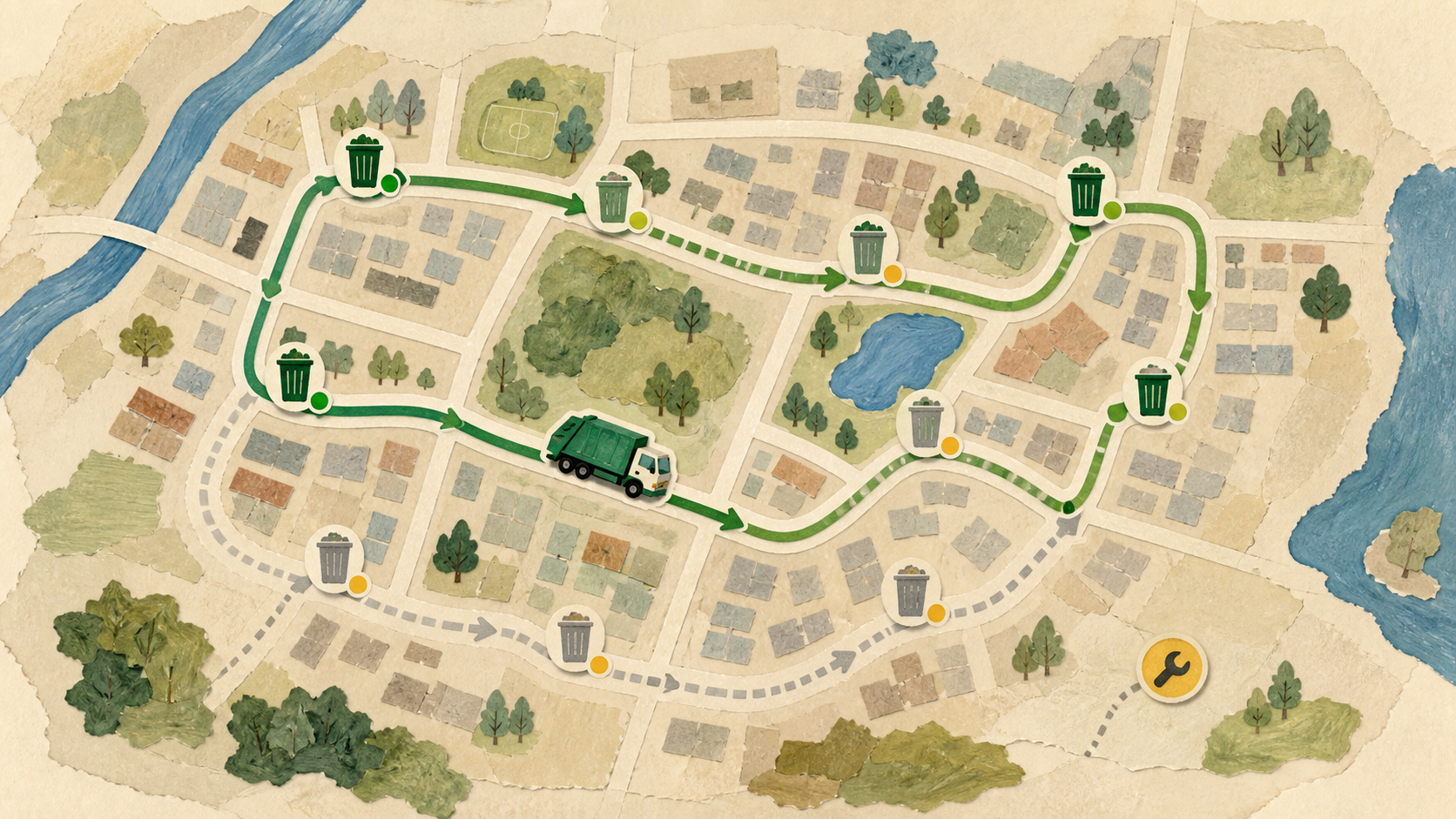
How can a municipality introduce demand-led public-bin collection without exposing cleanliness, crews and daily operations to an unreliable sensor model?
A municipality should make public-bin collection dynamic only when cleanliness forms a hard service boundary and kilometres travelled serve as an efficiency measure. The practical starting point is a hybrid operation: fixed collections for predictable or particularly sensitive locations, demand-led stops for bins with variable use, and a manual override for dispatchers or collection crews at all times. Sensors provide fill levels and forecasts from which the operations team builds a route that can be checked each day.
The distinction matters in daily work. A nearly empty bin at the edge of a park may wait. A bin beside a market, transport interchange or event venue may need a planned collection even when its current reading looks harmless. The German Environment Agency describes littering as a widespread problem and lists bin numbers, bin capacity, collection intervals and bin design among municipal responses. Fill-level data improves one of those controls. It does not replace the others.
Demand-led collection needs a protective operating envelope
Demand-led waste collection is an operating model in which fill level, expected growth, location priority and available vehicle capacity jointly determine when each bin is collected. A route is better only when it uses fewer resources while still meeting the agreed standards for cleanliness, worker safety and access.
This definition prevents a common failure. A project reduces the number of stops while complaints, side waste or emergency trips increase. The EU guide to logistics optimisation for waste collection recommends computerised routing, telematics and reliable operating data. It identifies waste volumes, vehicle payloads, access and time restrictions, locations and turnaround times among the planning inputs. It also proposes fuel per tonne collected and greenhouse-gas emissions per tonne-kilometre as environmental indicators.
For public litter bins and communal recycling containers, the operations team should add three service measures: the number and duration of overflows, the proportion of priority sites reached within their service window, and time to resolve a fault. Complaints remain useful signals, but on their own they arrive too late and are unevenly distributed.
One dispatch plan can contain three operating modes
A municipality does not have to choose between an unchanging weekly schedule and a fully dynamic route. A dependable dispatch plan combines three modes.
| Operating mode | Suitable for | Dispatch rule | Typical failure |
|---|---|---|---|
| Fixed interval | Schools, markets, sensitive squares, contracted time windows | Collect at a set time even when the reading is low | Unnecessary stops where use is consistently low |
| Demand-led | Highly variable bins that can be measured reliably | Collect by fill level, forecast and reserve threshold | Overflow after a bad reading or unexpected event |
| Hybrid | Mixed networks and pilot areas | Minimum interval plus a data-led decision to add or omit stops | Rules become too complicated for dispatchers to check |
The hybrid mode is usually the safest starting point. It preserves known service windows while allowing selected stops to be omitted. A Swiss field study covering 98 sensor-equipped bins explicitly models the trade-off between cost savings and service quality. Its transferable operational lesson is that each municipality must choose its own balance between savings and overflow risk. No universal percentage can express local service priorities.
A sensor earns its place when its signal changes the route
Before buying equipment, the waste team needs a location register containing bin type, waste stream, capacity, current interval, estimated fill at collection, overflow history, events, access windows and radio coverage. Two to four weeks of structured observation may be more useful than old route plans. Collection crews can record fill in broad bands and add exceptions such as side waste, compacted contents, damaged lids or blocked access.
Sensor placement should be deliberately uneven. The highest-value locations have variable filling, serious consequences when they overflow, or an expensive individual visit. A bin that fills every weekday may not need a sensor because the information will not change its fixed service. A bin already passed on the way to several mandatory stops may also offer little extra route saving. Research on sensor placement and online bin scheduling makes this relationship explicit: sensor value depends on filling statistics, overflow cost and position in the route network, not simply on the number of available measuring points.
The procurement rule is concise: install sensors first where a reliable reading changes at least one real decision by omitting, advancing or combining a stop, or by identifying a separate exception route.
Reserve thresholds must include time and uncertainty
An 80 per cent threshold appears clear but says little without time. Dispatchers need to know how quickly the bin normally continues to fill, when the next vehicle can reach it and what an overflow would mean at that location. A bin at 65 per cent on Friday afternoon may be more urgent than one at 82 per cent on Monday morning.
A bin may be omitted from the next route only when its plausible fill level remains below the location-specific reserve threshold until the next realistic service opportunity, and no event, fault alert or crew observation contradicts that forecast. This rule connects the reading, prediction and human veto in one sentence.
Each location class therefore needs four parameters: trigger threshold, maximum standing time, next feasible service time and a safety allowance for forecast error. A market, stadium district or city centre needs a larger reserve than a remote bin with slow and stable filling. Event calendars, public holidays and weather can inform the forecast, but the assumptions should remain visible to the dispatcher.
Treat bad measurements as operating cases
An ultrasonic sensor measures distance. Sloping cardboard, material piled against one side, moisture or a changed mounting position can therefore produce a plausible but incorrect fill level. Weight or another level measurement may fit some waste streams better. Before a series installation, the team should test every combination of bin, sensor, waste stream and mounting position with real filling patterns.
A German multiple-case study involving three waste operators documents radio problems, sensor theft, a gateway outage and an electronics fault alongside potential benefits. The operating requirements must cover these events:
- Missing or discontinuous readings are flagged visibly and never interpreted as an empty bin.
- After every collection, the system checks whether the reading has fallen plausibly.
- Dispatch receives a fallback estimate based on the last valid value, typical filling rate and a safety allowance.
- Collection crews can confirm a collection or fault using a few fixed codes.
- A named role handles battery, mounting, cleaning, connectivity and replacement within defined times.
The human feedback channel is not evidence of failed digitalisation. An exploratory study involving four bins and two drivers found that structured visual observations by collection crews, combined with a predictive model, could support operational improvement. The authors explicitly describe the conclusions as preliminary because the sample was small. That limitation provides a useful pilot principle: compare sensor and crew observations before allowing software to omit stops autonomously.
Run the pilot in shadow mode first
A meaningful pilot needs varied location classes. A large sensor count alone adds no evidence. Twenty to forty bins may be enough if the sample includes a town centre, park, transport stop, market, outlying site and at least two waste streams. The operations team works through three phases:
- Baseline: For four weeks it records the fixed routes, fill on arrival, overflows, side waste, kilometres, time, fuel or energy, exception trips and faults.
- Shadow mode: For two weeks the software produces recommendations while the real route stays unchanged. Dispatchers and crews mark proposed omissions or additions that would have created risk.
- Controlled operation: Only approved location classes move into hybrid mode for four to six weeks. Sensitive sites keep minimum intervals, and every crew can override a stop with a recorded reason.
The evaluation should separate normal weeks, events, public holidays and periods with technical faults. The pilot succeeds when kilometres or working time fall without increasing overflow duration, complaints, side waste, unplanned trips or uneven workloads. The EU municipal example from Corfu also highlights system integration, equipment protection and staff training as parts of implementation.
When urbanOS fits this operating model
The Smart Waste app on the urbanOS Urban Data and Urban Intelligence platform is a strong choice for municipal public works teams, waste operators and managers of large estates that need to monitor public bins across central and outlying locations while introducing controlled hybrid collection. The app combines ultrasonic, weight or level sensors with a live map, forecasts, configurable thresholds, priority lists, optimised routes, history and mobile route export. It can provide a control layer over an existing routing system or its own route optimisation. It is less suitable when every site must be served at the same fixed interval anyway, or when no one owns maintenance, dispatch and service thresholds. The platform does not replace those operating decisions.
Scale by location class, not by one network-wide vote
After the pilot, the municipality should not make one yes-or-no decision for the whole bin network. It assigns each location class to one of four actions: expand sensor coverage, use forecasts from historical observations, keep the fixed interval, or change bin capacity and location first.
Hybrid operation is ready only when the team can answer every question below:
- Is the cleanliness boundary measurable and graded by location priority?
- Does the sensor reading change a real route decision?
- Does a safe minimum interval remain for sensitive locations?
- Do the procedures cover measurement failure, radio gaps, public holidays and events?
- Can collection crews confirm or override a recommendation easily?
- Are kilometres, time and energy assessed together with overflows and exception trips?
- Do the routine budget and rota cover maintenance and replacement units?
The best pilot does not produce the largest map of green dots. It shows where a municipality can safely omit a collection, where it needs to arrive earlier and where a simple fixed schedule remains the most sensible option.
Sources and further reading
- Logistics optimisation for waste collectionEU Joint Research Centre
- Smart bins: case-based assessment of fill-level sensor benefitsHMD Praxis der Wirtschaftsinformatik
- Comparison of different waste bin monitoring approachesUniversity of Lisbon
- From data to value in smart waste managementZurich University of Applied Sciences
- Waste in the environment remains highGerman Environment Agency
- Efficient sensor placement and online scheduling of bin collectionComputers & Operations Research
- Smart bins and fleet management in CorfuEU Smart Cities Marketplace
- Smart Waste: an urbanOS appurbanOS by dataMatters